This web page is a concept developed by Chris Lysy of freshspectrum.com for educational purposes.  You can see how the post was created, and all of the original materials by following this link.

Back to Front Page
Economic Rankings
Children in Poverty
Stable Parent Employment
High Housing Cost Burden
Teens Not in School/ Not working

Economic Well-Being

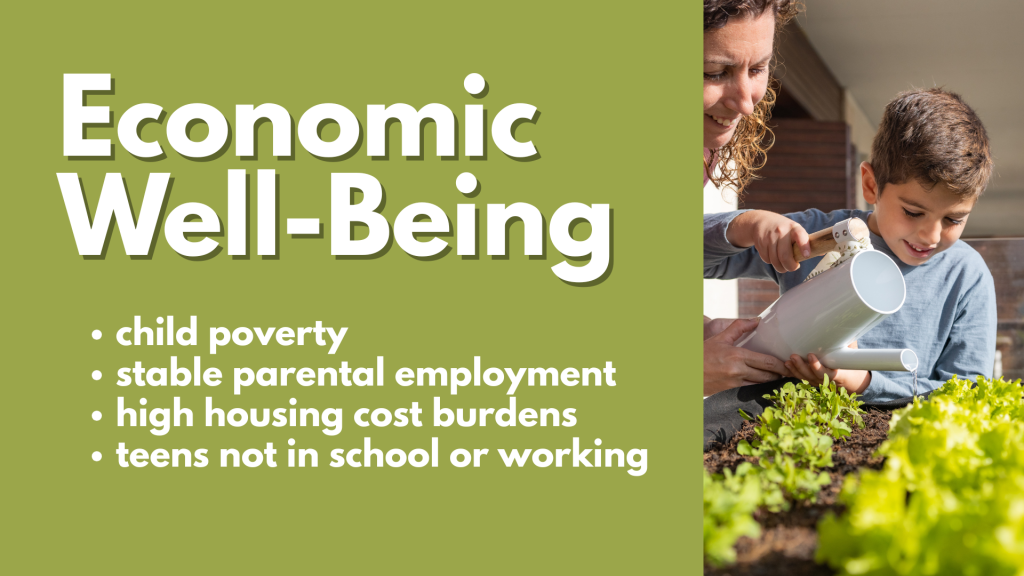
Indicators: child poverty; stable parental employment; high housing cost burdens; teens not in school or working

Children do better when their families have enough money to cover the basics — housing, food, health care, and stable child care. When families can’t meet those needs, it affects kids in ways that can last a lifetime.

This section looks at four measures of family financial security. Together they show not just whether families are poor, but whether their situation is stable. A family can be above the poverty line and still be one missed paycheck away from losing housing. A parent can be employed and still not have steady hours or predictable income.

States that rank well here tend to have lower costs of living, stronger labor markets, and more access to public supports. States that rank poorly often have a combination of low wages, high housing costs, and fewer safety net programs.

Economic Rankings
Children in Poverty
Stable Parent Employment
High Housing Cost Burden
Teens Not in School/ Not working

1. Children in Poverty

KIDS COUNT definition: The percentage of children under age 18 who live in families with incomes below 100% of the U.S. poverty threshold. In 2023, a family of two adults and two children lived in poverty if annual income fell below $30,900. Source: American Community Survey.

What moves this number: Direct cash to families works. The 2021 expanded Child Tax Credit cut child poverty from 14% to 5.2%. When it expired, poverty rebounded to 12.4% within a year.

A few sources for additional context:

Economic Rankings
Children in Poverty
Stable Parent Employment
High Housing Cost Burden
Teens Not in School/ Not working

2. Children Whose Parents Lack Secure Employment

KIDS COUNT definition: The share of children under 18 where no parent works at least 35 hours per week for at least 50 weeks per year. For single-parent families, the resident parent; for married couples, neither parent. Children living with no parent are also counted. Source: American Community Survey.

What moves this number: Job quality matters as much as job access. Income that swings up and down month to month harms children beyond just earning less — unstable schedules and gig work count here even when unemployment is low.

A few sources for additional context:

Economic Rankings
Children in Poverty
Stable Parent Employment
High Housing Cost Burden
Teens Not in School/ Not working

3. Children in Households with High Housing Cost Burden

KIDS COUNT definition: The percentage of children under 18 who live in households spending more than 30% of pretax income on housing costs, including rent, mortgage, taxes, and insurance. Source: American Community Survey.

What moves this number: Housing subsidies and eviction prevention lower this number directly. Only about one in four eligible families receives housing assistance — that gap is a policy choice, not a capacity limit.

A few sources for additional context:

  • Eviction Lab (Princeton) — national eviction data by city, searchable.
  • Matthew Desmond — Poverty, by America (2023) — argues unaffordable housing results from specific policy decisions.
  • National Low Income Housing Coalition — “Out of Reach,” hourly wage needed to afford rent in every state.
Economic Rankings
Children in Poverty
Stable Parent Employment
High Housing Cost Burden
Teens Not in School/ Not working

4. Teens Not in School and Not Working

KIDS COUNT definition: The percentage of teenagers ages 16–19 not enrolled in school (full or part time) and not employed (full or part time). Source: American Community Survey.

What moves this number: Reconnection programs, mentoring, and economic opportunity for young people reduce disconnection. COVID pulled many teens out of school who never returned — extended disconnection compounds over time.

Back to Front Page

This dashboard was developed by Chris Lysy at freshspectrum.com as part of the Before and After series — adapting publicly available research to make it more accessible. It is an attempt to recreate the 2025 interactive data book, using the interactive format to share additional data.