This web page is a concept developed by Chris Lysy of freshspectrum.com for educational purposes. You can see how the post was created, and all of the original materials by following this link.
What Five Years Taught Three Communities About Keeping Families Together
A storytelling dashboard based on the Child Welfare Community Collaborations cross-site evaluation
About This Project
Between 2018 and 2019, the Children’s Bureau — part of the U.S. Department of Health and Human Services — awarded five-year grants to 13 organizations across the country. The goal was ambitious: mobilize communities to build collaborative, multi-system approaches to preventing child abuse and neglect before families ever reached a crisis point.
The initiative was called the Building Capacity to Evaluate Child Welfare Community Collaborations Project, or CWCC. Grantees included state agencies, nonprofits, and Native American tribal organizations. Together they spanned nearly every region of the country.
To learn from what these projects built, the Administration for Children and Families contracted with Abt Global and Child Trends to conduct a cross-site process evaluation — interviewing hundreds of people, surveying partners annually, and tracking what worked, what didn’t, and what might be worth doing elsewhere.
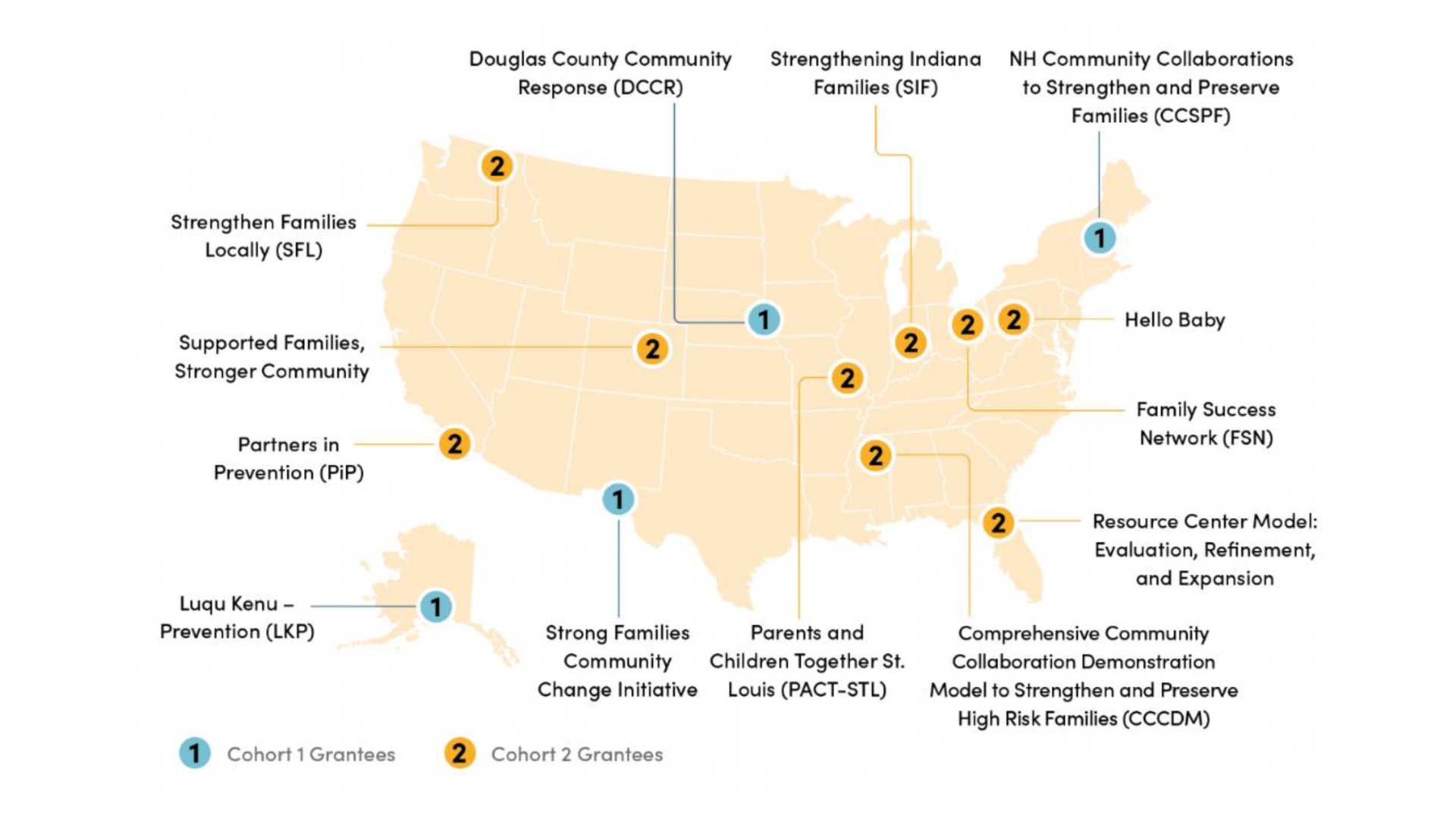
Grantee Stories
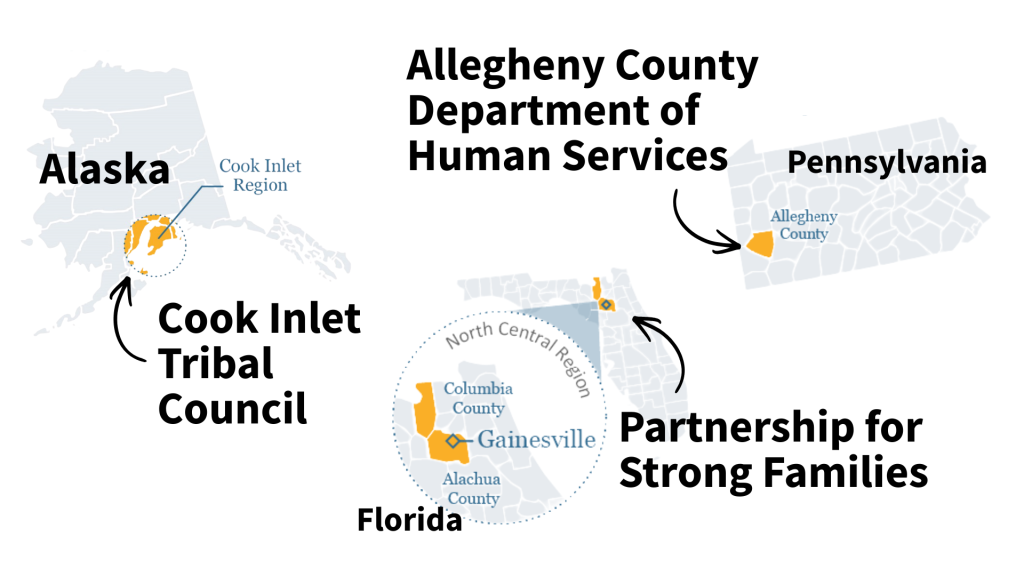
This concept report is based on the stories of three of the thirteen grantees.
Just click on an article to read the individual grantee story.
Everyone is Family: The Story of Luqu Kenu
Cook Inlet Tribal Council in Anchorage, Alaska — working to reconnect Alaska Native families with culture, community, and support in a city far from home.
Hello Baby: How Allegheny County Tried to Reach Families Before the Crisis
Allegheny County Department of Human Services in Pennsylvania — trying to reach families with newborns before something went wrong, using data in ways child welfare had never quite tried before.
Place-Based and Community-Driven: The Story of Partnership for Strong Families' Resource Centers
Partnership for Strong Families in North Central Florida — running neighborhood resource centers where families could walk in, get help, and keep coming back.
Three places. Three approaches. Five years. A lot of hard-won lessons.
What we learned from these three grantees.
When Communities Lead, Families Thrive
Across the country, communities are finding new ways to support families before a crisis ever begins. The grantee stories represent five years of learning from three very different places — urban Alaska, suburban Pennsylvania, and rural Florida — united by a common goal: keeping children safe and families together.
What they discovered looks less like a program manual and more like a set of hard-won truths. Trust takes longer to build than anyone plans for. Data matters, but only if it reflects what communities actually need. Cultural relevance isn’t a nice-to-have — it’s the difference between a family walking through the door or not. And when funding gets scarce, collaboration gives way to competition, which means adequate and sustained resources aren’t just a practical concern, they’re an equity one.
These projects also learned that families aren’t problems to be solved — they’re partners to be engaged. The most effective staff were the ones who showed up where families were, listened before they prescribed, and came from the same communities they served.
None of this happened overnight. Three years in, as one leader put it, programs were still learning “very fundamental things.” That patience — and the institutional commitment to sustain it — may be the most transferable lesson of all.
How They Found Each Other — Building Partnerships
Nobody started from nothing. Cook Inlet Tribal Council had decades of relationships with Alaska Native families and other tribal programs to draw on. Allegheny County had a long-established Children’s Cabinet that became Hello Baby’s backbone. Partnership for Strong Families had been running family resource centers in Gainesville for fourteen years before the grant arrived.
What the grant did was give them room to be more intentional. They used heat maps to find neighborhoods with the most need and fewest resources. They knocked on doors in Lake City before opening a single center. They held listening sessions, conducted community scans, and asked who was missing from the table — then went looking for them.
The hardest partners to find weren’t the ones with capacity gaps. They were the ones where trust had to be rebuilt first. In Alaska, finding mental health and legal partners took longer than everything else because cultural compatibility couldn’t be rushed. In Pennsylvania, community organizations worried that partnering with a county human services department would make families see them as an arm of child welfare — a fear that had to be actively managed throughout the project.
The partnerships that worked best were networks where partners talked to each other directly, shared resources across the whole system, and saw themselves as working toward the same goal rather than competing for the same families.
What They Actually Did — Implementation
Each project looked different on the surface. Alaska built cultural gatherings, family navigation, and a Tribal Wellness Framework. Pennsylvania built a three-tier system using a predictive risk model to match families to the right level of support. Florida ran neighborhood resource centers where families could drop in for help, connection, or just a conversation.
But underneath, they were all doing variations of the same things: meeting families where they were (literally — in homes, community spaces, hospital rooms, and fishing boats), connecting them to services they wouldn’t have found on their own, and building relationships strong enough that families would come back.
The most important word across all three projects was flexibility. None of them could implement what they planned. COVID shut down in-person work just as programs were finding their footing. An earthquake hit Anchorage two months after CITC received their grant. Florida’s foster care costs ballooned mid-project and forced staff layoffs. In every case, teams adapted — lighter-touch approaches, virtual check-ins, pivoting to concrete goods when intensive services weren’t possible — and kept going.
What Helped and What Got in the Way — Facilitators and Barriers
The thing that helped most, across all three sites, was trust. Not trust as an abstract value — trust as something built slowly through showing up consistently, hiring people from the communities being served, and being transparent about what the program was and wasn’t.
In Alaska, family navigators were Alaska Native themselves. In Pennsylvania, family support center staff lived in or near the neighborhoods they worked in. In Florida, resource center managers knew their patrons by name. These weren’t staffing accidents — they were deliberate choices that made the difference between families engaging and families walking away.
The things that got in the way were often structural. Redundant data collection frustrated families enrolled in multiple programs. Transportation and childcare barriers kept people from showing up. Medicaid billing requirements asked CITC to screen families for risk before building a relationship with them — exactly backwards from their philosophy. When funding got scarce in Florida, collaboration quietly curdled into competition.
And then there was time. Three years in, teams were still learning fundamental things. Every project said some version of the same thing: you can’t do this work fast, and anyone who expects community-level change on a grant timeline is going to be disappointed.
How They Used Data — and Where It Got Complicated
All three projects used data in sophisticated ways — heat maps to find communities in need, predictive models to match families to services, self-assessments to reshape programming that wasn’t working. When Florida’s data showed fathers weren’t engaging, they found a partner who worked specifically with teen dads. When Allegheny County’s analysis showed families scoring 19 on their risk model looked a lot like families scoring 20, they expanded the Priority Tier. Data drove real decisions.
But data was also a source of real friction. CITC’s strengths-based philosophy kept running into deficit-based government systems. Their own assessment tools, designed with an indigenous lens, were still being refined when the grant ended. Allegheny County’s predictive risk model generated ongoing scrutiny and required two independent ethics reviews. Florida discovered that many of their patrons — the ones who came in once for emergency help and left — would never show up in their outcome data, even if that one visit changed everything.
The hardest data lesson was the simplest: the families most in need are usually the hardest to count.
What Comes Next — Sustainability
Nearly all of the strategies from all three projects are continuing in some form. That’s the headline. The infrastructure built over five years — the data systems, the partnerships, the frameworks, the trust — didn’t disappear when the grant ended.
But sustainability looked different at each site. Alaska is running leaner, with reduced staffing, still developing the Tribal Wellness Framework, and leveraging the Alaska Tribal Child Welfare Compact for ongoing policy influence. Pennsylvania secured state funding through the Needs Based Plan and Budget, and the Family Council launched in 2023 gives parents a permanent seat at the table. Florida lost one resource center entirely when foster care costs overwhelmed the parent organization, and the Lake City center — built entirely with grant funds — has the most uncertain future.
The honest version of sustainability isn’t “the program continues.” It’s “the community is different than it was.” The relationships built, the tools developed, the families who found their way to support they wouldn’t have found otherwise — those don’t disappear when a grant closes out. They’re harder to measure. But they’re there.
This dashboard was developed by Chris Lysy at freshspectrum.com as part of the Before and After series — adapting publicly available research to make it more accessible. It draws on three grantee profiles and the executive summary from the Child Welfare Community Collaborations cross-site process evaluation (OPRE, 2024), conducted by Abt Global and Child Trends.
The three grantee profiles retold here: Cook Inlet Tribal Council, Inc. (OPRE Report 2024-084); Allegheny County Department of Human Services (OPRE Report 2024-266); Partnership for Strong Families, Inc. (OPRE Report 2024-271). The cross-site executive summary: OPRE Report 2024-361.