This web page is a concept developed by Chris Lysy of freshspectrum.com for educational purposes. You can see how the post was created, and all of the original materials by following this link.
Grantee Stories
Place-Based and Community-Driven: The Story of Partnership for Strong Families' Resource Centers
Place-Based and Community-Driven: The Story of Partnership for Strong Families' Resource Centers
A five-year effort to expand and refine a family resource center network in North Central Florida
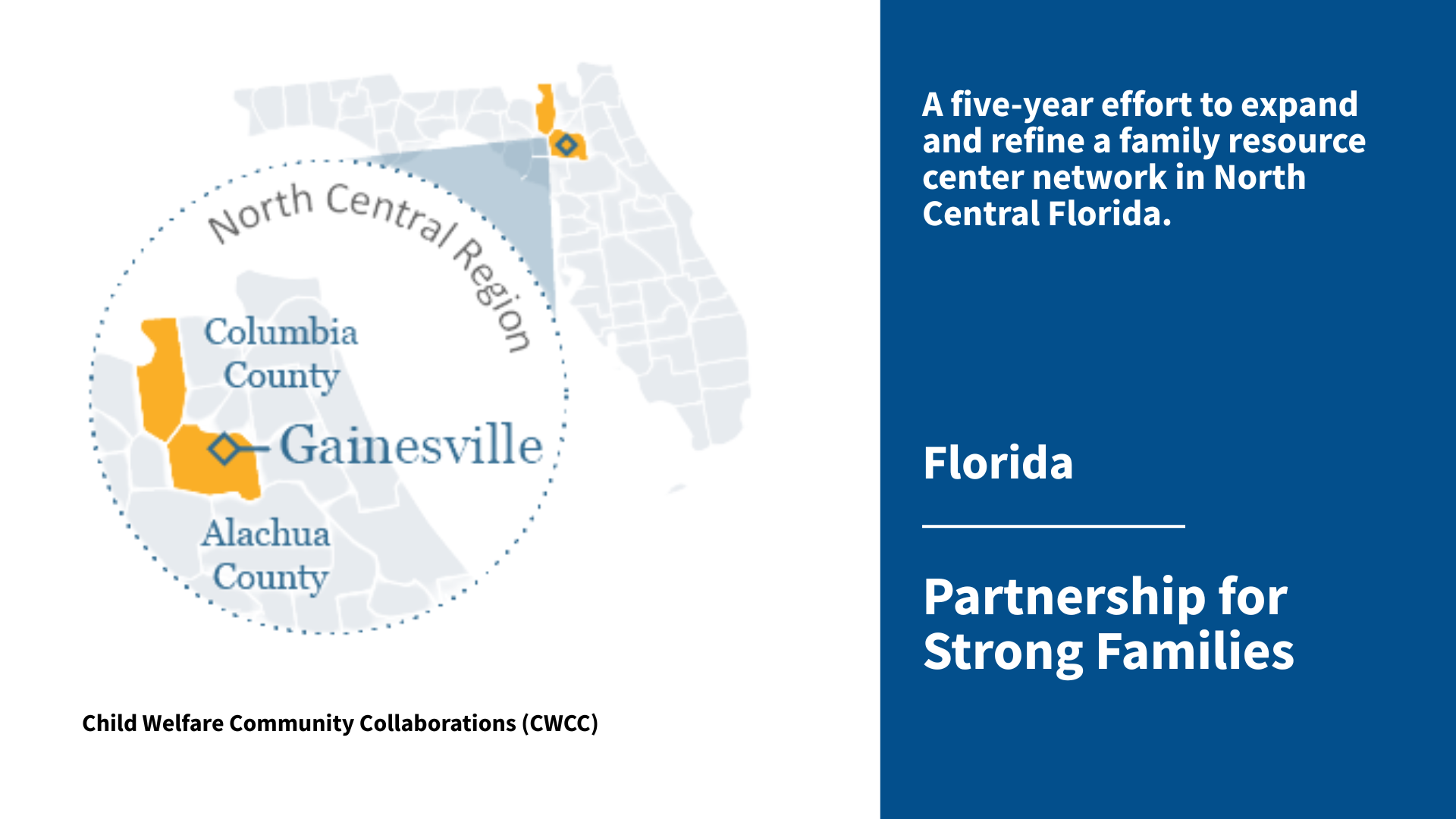
Partnership for Strong Families, Inc. (PSF) didn’t start this project from scratch. Their first family resource center opened in Gainesville over 14 years ago. By 2019, the four resource centers (RCs) participating in this project saw 34,754 visits.
What the CWCC grant funded wasn’t the creation of a model — it was the evaluation, refinement, and expansion of one already running.
PSF is the lead community-based care organization in North Central Florida, responsible for prevention, in-home services, foster care, and adoption across the region. The RC network sits within that broader system. The grant gave PSF the capacity to study what the centers were doing, adjust based on evidence, and open a fourth location in Lake City — a community with high need and a much smaller population than Gainesville.
The Communities They Served
The four resource centers were located in Alachua and Columbia counties, with three centered in Gainesville neighborhoods that accounted for a large proportion of the county’s maltreatment reports and removals from home. Those same communities had historically limited access to resources, higher rates of poverty, housing burden, and unemployment. Factors associated with abuse and neglect — including unemployment rate, kindergarten readiness, graduation rate, and unplanned pregnancies — were also elevated. Housing shortages and homelessness had been rising, made worse by COVID.
Three of the four RCs existed before the grant: the Library Partnership Resource Center, the Southwest Advocacy Group (SWAG) Family Resource Center, and the Cone Park Library Resource Center. The fourth — the NorthStar Family Resource Center in Lake City — opened in March 2021, built from scratch using the same model.
All services across all four centers were organized around one framework: the Strengthening Families and Protective Factors Framework. Every service offered — by RC staff or external partners — had to address at least one of five protective factors: parental resilience, social connections, knowledge of parenting and child development, concrete supports in times of need, and social and emotional competence of children.
Finding Partners
PSF used data on child maltreatment to generate heat maps identifying zip codes with higher concentrations of abuse reports and fewer existing resources. They layered in socioeconomic data — unemployment rate, housing burden, household composition, poverty rate — to understand where the need was concentrated. Then they developed partnerships in those zip codes, focused on organizations that could address the identified gaps within the Protective Factors Framework.
For the Lake City location, PSF went door to door. They conducted a community-wide needs assessment before the NorthStar center opened, reviewed what services already existed, and used the Protective Factors Framework to categorize gaps and plan for service delivery.
This approach also addressed a real concern in the community: that a new RC would compete with existing services for limited funding. By engaging local partners early — including retired school personnel who still had contacts in the school district — PSF helped ease those fears and position the NorthStar center as a complement to existing services, not a competitor.
Partners fell into four main categories: public agencies (the Department of Children and Families, public health, the Sheriff’s Office, transit, workforce development, and others) that accepted referrals and in some cases offered on-site consultation; philanthropic and business organizations including Casey Family Programs, Wells Fargo, TD Bank, and local businesses like Satchel’s Pizza and Keller Williams Realty; community-serving organizations including domestic violence programs, food banks, behavioral health providers, churches, and Head Start; and educational organizations that supplied interns from Santa Fe College, the University of Florida, and other institutions.
Each RC developed its own mix of partners over time, reflecting the needs of its specific neighborhood.
What the Resource Centers Actually Did
Family Support Facilitators
The day-to-day work of connecting families to services fell to Family Support Facilitators (FSFs) — staff described in the profile as committed and flexible people who knew their patrons and their community partners well. FSFs identified what families needed, connected them to available services, adapted to the community’s changing needs, and kept looking for ways to reach people who weren’t yet coming through the door.
Resource center managers handled outreach to potential patrons, organized health fairs and walking groups, secured grants and donations from the community, managed operations, supervised staff and volunteers, and ran programs like after-school activities and clothes closets.
Resource Center Advisory Councils
Each RC had an advisory council made up of partner agency representatives, community members, and patrons. The advisory councils helped identify barriers, surface gaps in services, and flag when particular services were overutilized or had long waiting lists. In Lake City, the existing Children’s Partnership Councils merged with the RC advisory council, since their missions were aligned.
Equity Initiatives
PSF received supplemental CWCC funding to address racial disparities. They developed a Community Leadership Development Program that included a Youth Advisory Council organized around three community groups. Youth advisors worked on addressing food deserts — including planting a vegetable garden — low literacy, programming gaps for males, and access to health and physical activity programs.
The centers also developed Spanish-language information rack cards and contracted with a community partner for translation services. RC staff received equity and inclusion training, including working with children and teens from diverse backgrounds, and the physical spaces were made welcoming to all through signage and intentional design.
What the Data Showed — and Changed
The Strengthening Families Self-Assessment (SFSA) was administered regularly to RC staff, patrons, and community partners. Results weren’t just filed away — they changed what the centers did.
The SFSA identified low engagement by fathers as a gap. One RC started a Father’s Support Group. Another partnered with an organization that works specifically with teen fathers.
Parenting groups weren’t popular. The RCs shifted to targeting that same protective factor through social gatherings and other activities that let patrons connect with each other informally.
The Protective Factors Survey found lower scores on parenting knowledge. RCs began offering additional opportunities for families to share parenting resources and information.
The SFSA process also helped open the NorthStar center in Lake City — it helped overcome community resistance by demonstrating that the new center would fill gaps in existing services rather than undermine them.
Each RC had a research coordinator funded through the grant who collected and analyzed data in the Community Module — the shared internal data system used across all four centers. The grant also funded improvements to that system, adding data fields for patron demographics and ensuring staff were accurately capturing all services offered, not just services requested.
What Got in the Way
The most significant barrier wasn’t programmatic — it was financial.
The unprecedented cost of out-of-home care in Florida hit PSF hard during the grant period. Staff layoffs at the agency level rippled into the resource centers. RCs were understaffed, particularly when interns completed their rotations. Some services had to be temporarily suspended. Operating hours were adjusted.
And then: the Cone Park Library Resource Center closed on August 11, 2023. PSF leadership described it as a decision made after much thoughtful consideration, with a commitment to minimizing impact on patrons. The closure was driven primarily by the crisis in foster care costs.
The sustainability section of the profile is candid about a related tension: limited and unequally distributed funding created a sense of competition among service providers in the community, which in turn diminished trust and collaboration. The lesson PSF drew from this is direct — adequate funding can reduce competition and encourage collaboration; when funding is scarce, agencies hoard rather than share resources.
Raising awareness of RC programs was also a persistent challenge, especially for programming aimed at fathers.
The Measurement Challenge
PSF’s evaluation team identified a fundamental tension in trying to measure the impact of a resource center model.
Many patrons visit an RC once, looking for quick, specific help — a referral, a pantry visit, a question answered. They’re unlikely to complete evaluation surveys. Other patrons develop long-term relationships with staff and come back repeatedly. These two groups have very different levels of engagement with any formal evaluation process.
The evaluator’s initial enrollment projections were based on total patron visits, without accounting for how many of those visits were one-time. The project ended up overestimating the number of patrons who would formally enroll in the study. Follow-up data was especially hard to collect from one-time visitors.
This is one of the most transferable insights in the profile: resource center models serve people on a spectrum from single transaction to ongoing relationship, and evaluation designs built around the latter will systematically undercount the former.
What They Learned
PSF described four key lessons after four years.
Building trust and open communication is key to successful partnerships and community participation. Regular meetings, clear reporting on progress, and openness to learning from partners all matter. Partners need to understand the RC’s mission and their own role within it. Trust builds slowly and depends on consistency.
Adequate funding for services is a key issue. Scarcity creates competition. Competition undermines collaboration. This isn’t a peripheral observation — it’s described as a direct lesson from watching how providers behaved when resources were tight.
Counting patrons served is complicated. The one-time visitor who gets a referral to stable housing may have received something more valuable than a patron who attended twelve workshops. But only one of them shows up easily in participation data.
Developing service offerings based on community input is key to service uptake and participation. RCs conducted needs assessments and adapted what they offered in response. Services designed without that input didn’t get used.
What Comes Next
PSF completed the five-year grant period in September 2024. Three of the four resource centers continue operating. The NorthStar center in Lake City — funded entirely by the CWCC grant — faces the most uncertain future, though PSF has secured a state grant through Community-Based Child Abuse Prevention (CBCAP) funds and received a grant from the Children’s Trust of Alachua County.
The improved Community Module continues. The Strengthening Families Self-Assessment continues. PSF has long relied on volunteers and interns to supplement staffing, and anticipates that model continuing.
PSF is also working with Community Attributes, Inc. to develop a web-based mapping application that will allow staff to see layered community trends — child welfare outcomes alongside other social indicators — at the neighborhood level. That tool was still in the planning stages at the time this profile was published.
Grantee Stories
Place-Based and Community-Driven: The Story of Partnership for Strong Families' Resource Centers
This dashboard was developed by Chris Lysy of freshspectrum.com as part of the Before and After series. You can see how the post was created, and all of the original materials by following this link.
It draws on three grantee profiles and the executive summary from the Child Welfare Community Collaborations cross-site process evaluation (OPRE, 2024), conducted by Abt Global and Child Trends.
The three grantee profiles retold here: Cook Inlet Tribal Council, Inc. (OPRE Report 2024-084); Allegheny County Department of Human Services (OPRE Report 2024-266); Partnership for Strong Families, Inc. (OPRE Report 2024-271). The cross-site executive summary: OPRE Report 2024-361.