This web page is a concept developed by Chris Lysy of freshspectrum.com for educational purposes. You can see how the post was created, and all of the original materials by following this link.
Grantee Stories
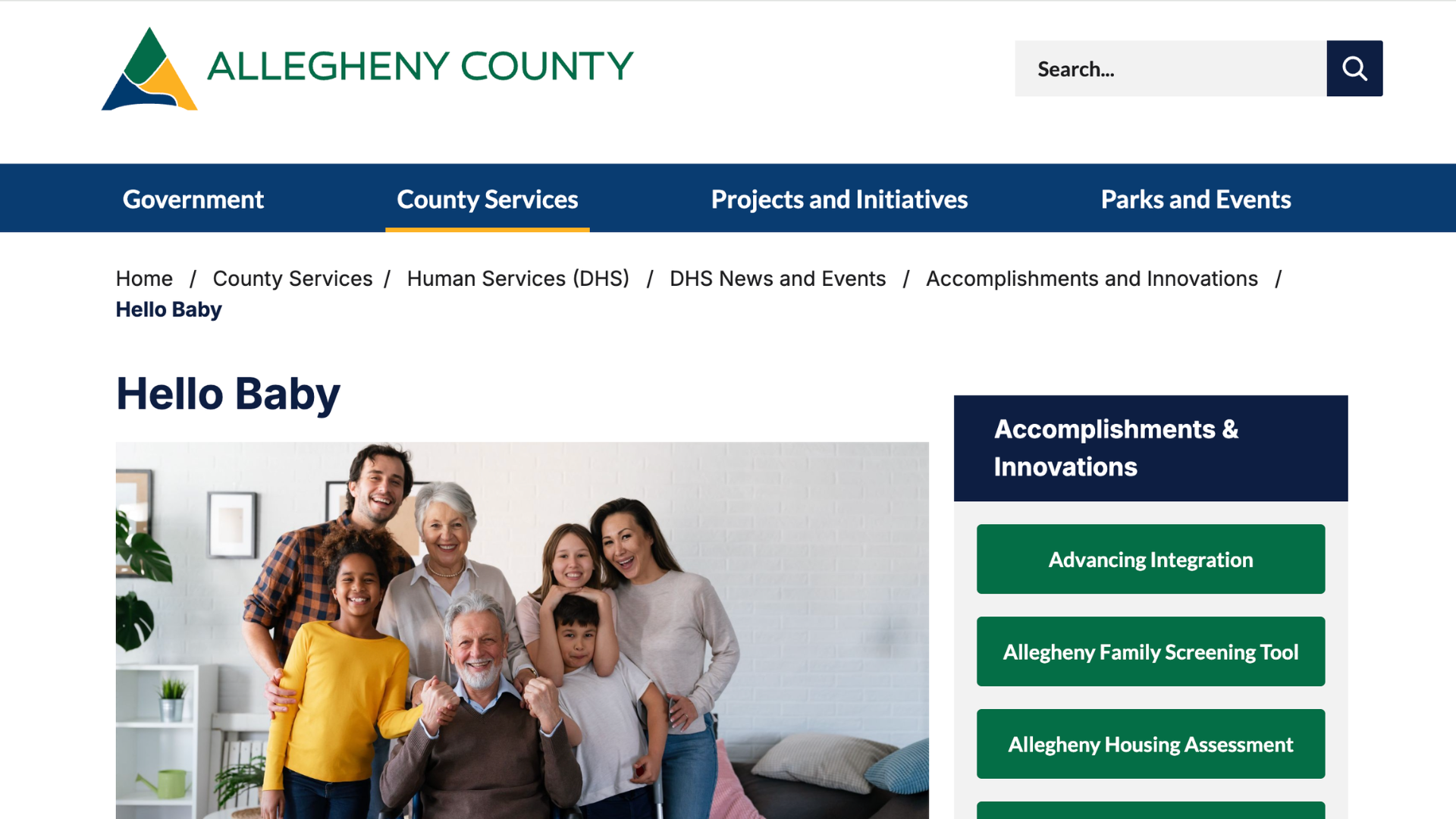
Hello Baby: How Allegheny County Tried to Reach Families Before the Crisis
Hello Baby: How Allegheny County Tried to Reach Families Before the Crisis
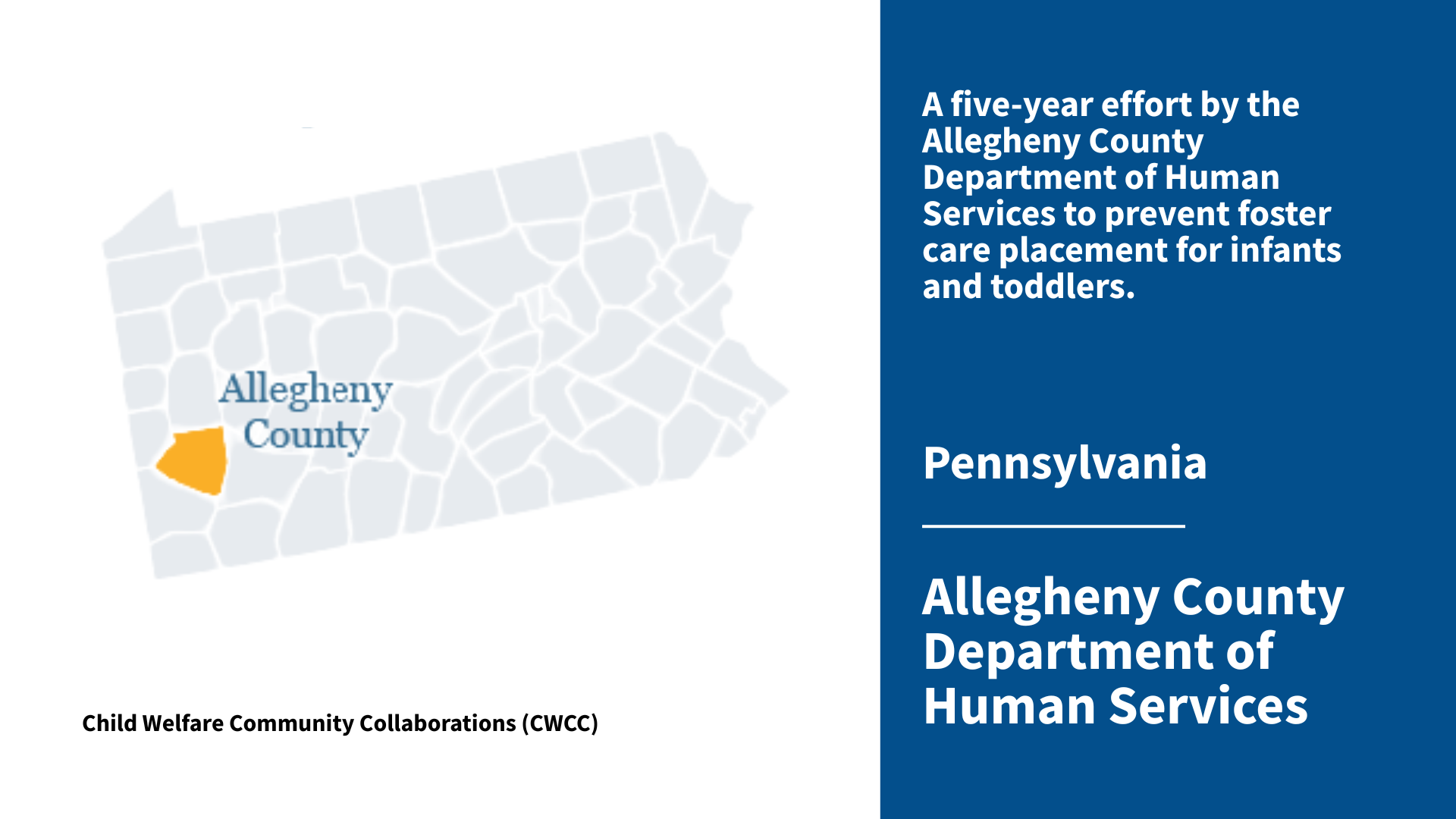
A five-year effort by the Allegheny County Department of Human Services to prevent foster care placement for infants and toddlers
From 2009 through 2016, almost 80% of the children in Allegheny County who died from child abuse and neglect were under the age of three. In half the cases where a child was seriously injured or killed, child welfare had never received a referral to that family. There had been no opportunity to help before the tragedy occurred.
That statistic shaped everything about Hello Baby. If the system was only reaching families after something had already gone wrong, the question became: how do you find families earlier?
Allegheny County Department of Human Services (ACDHS) had spent thirty years leading prevention initiatives and exploring predictive risk modeling as a tool for identifying families who might need support. Hello Baby built on that history. The grant was awarded in September 2019.
The Three-Tier Model
Hello Baby aimed to reach every family with a newborn in Allegheny County — and then match the level of support to the level of need.
The program used a predictive risk model (PRM), designed by the University of Auckland in New Zealand, to assign families a risk score from 1 to 20. The score drew on 59 data features from Allegheny County’s integrated administrative data warehouse — things like child birthweight, mother’s age, and counts of previous child welfare referrals. These features were chosen based on their relationship to a child’s risk of being removed from the home by age three. A family’s tier ranking was also correlated with other adversities, including the mother being booked in jail, homelessness, maternal mortality, and preventable injury or death.
Services fell into three tiers based on that score:
The Universal Tier was available to all families with newborns in the county, regardless of risk score. Nurses and social workers distributed Hello Baby bags to all labor and delivery patients at the three primary birthing hospitals — UPMC Magee-Women’s Hospital, Allegheny Health Network’s West Penn Hospital, and the Family Birth Center at St. Clair Hospital. United Way 2-1-1 managed an online chat and phone referral line, and Nurture PA provided a text-based service where volunteer peer mentors reached out to families who expressed interest.
The Family Support Tier served families with a PRM score of 17 or 18, along with hospital referrals. Family support centers — staffed by people who lived in or near the neighborhoods they served — connected families to home visiting, education and coaching, housing navigation, job search assistance, fatherhood programs, legal assistance, and tangible aid like diapers, food, and formula.
The Priority Tier served families with a PRM score of 19 or 20 — the highest-need families in the county. Two providers delivered intensive support: Healthy Start (selected through a competitive RFP process) and the University of Pittsburgh’s Family Check Up team (added in 2022). Teams of family engagement specialists, navigators, and family coaches worked with these families and helped expedite their enrollment in services like childcare, housing assistance, job search support, and treatment.
The intensive tiers began as a pilot in the Mon Valley area of the county — about one-quarter of the total population — before expanding countywide in February 2022.
Building the Partnership
Hello Baby was built on infrastructure that already existed. The Children’s Cabinet — a long-established community advisory body — provided the governance structure. ACDHS drew on existing relationships to identify partners and convene the collaboration.
Partners fell into two main categories: public agencies providing governance, oversight, and concrete supports; and community-serving organizations delivering direct services at each tier. In addition to Healthy Start and Family Check Up for the Priority Tier, partners included Family Support Centers, ACTION Housing, Alliance for Infants and Toddlers, Footbridge for Families (which provided one-time financial assistance up to $2,500), United Way of Southwestern Pennsylvania 2-1-1, Nurture PA, and all county birthing hospitals. Community Kitchen Pittsburgh and several Meals on Wheels providers delivered prepared meals twice a week for six weeks to the highest-need families.
The collaboration was structured through several bodies that evolved over time. An initial Hello Baby Advisory Committee, focused on the PRM rollout, was dissolved in 2022 and replaced by the Hello Baby Support Network — a monthly forum for community partners and providers — and the Hello Baby Partners System, which convened leadership staff to examine systems and address service delivery questions. The Hello Baby Family Council, launched in August 2023, created a forum specifically for parents to share experiences and contribute to program decisions.
One partner described what collaboration made possible beyond individual agency capacity: “We contributed to an emergency basic needs fund. So, any partner — and this isn’t just for Hello Baby. This is for any family with children in Allegheny County. …a common mechanism for providing up to $700 and get your needs met. …we’ve started to make headway on having like a common set of services that the entire partnership network can take advantage of.”
What Hello Baby Actually Did
Centralized Outreach
Launched in August 2022, the Hello Baby Centralized Outreach strategy standardized how the program reached out to referred families. Four outreach teams managed referrals from the PRM algorithms, hospitals, child welfare, Plans of Safe Care, and the Early Learning Resource Center. Centralized outreach took the burden of initial referral management off service providers so they could focus on developing deeper relationships with families.
Priority Services
For the highest-need families, teams of family engagement specialists (peers), navigators (social workers), and family coaches (therapists) provided intensive outreach and worked with other county agencies to expedite enrollment in services. Healthy Start developed individualized care plans with families and revisited them every 90 days to celebrate progress, address barriers, and plan next steps. Family Check Up used a three-part assessment process — a “Get to Know You” interview, a Child & Family Assessment, and ongoing Feedback sessions.
For families with substance-affected infants, hospitals started a Plan of Safe Care and then referred families directly to Hello Baby Priority providers.
Concrete Supports
Outreach workers found that families often arrived in crisis. The program provided temporary emergency rental and childcare assistance for families receiving services from Healthy Start or Family Check Up.
There was internal debate about this approach. Some community members and staff described concrete assistance as “putting band-aids on” and “building dependency.” ACDHS responded by explaining the rationale — including the documented benefits of concrete supports on infant brain development — and by expanding the practice thoughtfully.
ACDHS and United Way 2-1-1 also launched the Basic Needs & Stability Fund — a $700 stipend available to all ACDHS providers for families experiencing crisis. Originally funded through COVID-19 Emergency Relief funds through June 2022, ACDHS then leveraged state child welfare funds to extend support for rent and childcare beyond that date.
Meals for Families
To address food insecurity and post-partum stress, ACDHS partnered with Community Kitchen Pittsburgh — a local café with culinary skills-building opportunities for residents — and two Meals on Wheels providers to pilot a meal delivery program. Prepared meals were offered twice a week for six weeks to the highest-need families. The program later expanded to three additional MOW providers, delivering meals to moderate- and high-need families countywide.
Staff Training
The Camden Coalition trained Hello Baby Priority Tier providers on the COACH/RELATE model — COACH being a case management framework and RELATE a relational coaching model promoting adaptability and positive team dynamics. ACDHS later expanded COACH/RELATE training to family centers and other child-serving agencies. The ACDHS Integrated Program Services office provided training in trauma-informed care, motivational interviewing, and case conferencing. The ACDHS Equity and Inclusion team trained staff in recognizing and reducing bias and provided case consultation on sexual orientation and gender identity.
COVID and the Challenge of Building During a Shutdown
Hello Baby was in the early stages of program design when COVID hit.
COVID impacted everything. One interviewee said it affected things from “collaboration to program creation, to hiring.” The program pivoted to a “Hello Baby Cares” light-touch approach focused on providing concrete goods. Home visits stopped. Interactions moved to text and phone. Hospital staff were overwhelmed and may not have consistently provided Hello Baby materials to all families. United Way 2-1-1 reported being overwhelmed with COVID calls: “the challenge right now is just for 2-1-1 just being overwhelmed with some of the COVID calls and wondering if that’s affecting the number of calls that we’re receiving from families who may not want to wait on the line to reach a live person.”
Partner meetings, shifted to virtual, complicated relationship-building. Some meetings focused solely on Hello Baby and missed opportunities to address broader system-level issues. ACDHS revised the partnership and meeting structures as the project evolved.
The Data Challenge
The Predictive Risk Model
The PRM was central to Hello Baby — and also a source of ongoing scrutiny. ACDHS commissioned two independent ethical reviews of the methodology and maintained continuous engagement with the community and partners throughout implementation.
The model evolved. Initially, only families scoring a 20 qualified for Priority Tier services. Based on data analysis and community feedback, ACDHS found that families scoring 19 and 20 had similar characteristics and expanded eligibility to both. In October 2023, a second algorithm was launched specifically for hospital referrals — allowing families to be scored and connected to appropriate services immediately after referral rather than waiting for birth records.
As one informant described the shift from the old approach: it had “changed us from funding a bunch of good programs out there and hoping the universe gets people who could benefit to them.”
Data Sharing
Hello Baby built a data platform application to manage referrals across partners. Partners had varying comfort levels with sharing client data with ACDHS. Some shared only de-identified data; others asked families to sign consent forms. All arrangements were governed by contractual data sharing agreements.
Hard-to-Reach Families
Contact information in the ACDHS data warehouse was often outdated. Without a warm handoff from another agency, initial connection took longer than expected. Priority Tier partners described an ongoing dilemma of deciding how long to pursue families who weren’t responding.
To address this, ACDHS developed marketing strategies to incentivize engagement — including a $25 gift card for families who signed up at the hospital and a chance to win a $150 gift card — and implemented a centralized referral process where dedicated outreach specialists handled initial contact and then handed families off to the appropriate tier providers.
What They Learned
Hello Baby partners described three key lessons after four years of implementation.
Collaborative, community-based prevention approaches require time, commitment, and capacity to evolve. Interviewees highlighted the importance of committed leaders at both ACDHS and partner organizations, and of “consistent touch points” that kept people connected. They also noted that commitment to staff development, fair wages, and promotional opportunities supported the collaboration. One interviewee said: “Realistically, at three years, we’re all just learning very fundamental things about what’s going on. We can’t really expect any community-level changes for a really long time, so this has to be something that we’re all committed to continuing to do and not expect overnight success.”
Building relationships and trust with families and partners is key. Hello Baby network members found that addressing basic needs at the start helped build trust between families and providers. Program staff highlighted the importance of conveying that Hello Baby was “no strings attached support” with no expectations on families. Staff who were personable, non-judgmental, and able to connect through shared experiences were most effective.
Trust with partners also required attention. Community-based organizations needed to maintain their own identity — not be perceived as extensions of the county child welfare system.
Dedicated and centralized outreach and engagement staff promote successful recruitment efforts. As Hello Baby evolved, ACDHS and partners recognized that authentic, trusting family engagement required staff who were dedicated specifically to that task. Centralized outreach allowed other staff to focus on developing deeper connections with families rather than spending time on initial recruitment.
What Comes Next
Hello Baby completed its five-year grant period in September 2024. ACDHS has received state funding through Pennsylvania’s Needs Based Plan and Budget to support the program and expressed commitment to sustaining it through state, county, and private funding, though a reduction in child welfare funding could affect expansion plans.
The predictive risk model continues to be refined. The Hello Baby Support Network and Partners System continue to convene. The Family Council — launched in August 2023 to give parents a formal voice in program decisions — is ongoing.
Grantee Stories
Hello Baby: How Allegheny County Tried to Reach Families Before the Crisis
This dashboard was developed by Chris Lysy at freshspectrum.com as part of the Before and After series — adapting publicly available research to make it more accessible. It draws on three grantee profiles and the executive summary from the Child Welfare Community Collaborations cross-site process evaluation (OPRE, 2024), conducted by Abt Global and Child Trends.
The three grantee profiles retold here: Cook Inlet Tribal Council, Inc. (OPRE Report 2024-084); Allegheny County Department of Human Services (OPRE Report 2024-266); Partnership for Strong Families, Inc. (OPRE Report 2024-271). The cross-site executive summary: OPRE Report 2024-361.